Along with volunteer projects, there are many opportunities coming up for volunteers (or anyone else interested in issues relating to national parks) to learn or participate in seminars, discussions, or classes. Here's a sampling from my e-mail in-box:
July 10: Climate Change in National Parks Web-seminar SeriesThe National Park Service is pleased to present a series of web-based seminars on climate change offered bi-monthly starting July 10th, 2008. These web seminars will be facilitated by Dr. Leigh Welling, NPS Climate Change Coordinator. This series is intended to help connect NPS employees, volunteers, and partners with scientists and experts in the field of climate change research. Our goal is to provide a Service-wide forum where researchers can share credible, up-to-date information and research materials about the impacts of changing climate in national parks and where NPS employees, volunteers, and partners can participate in a discussion with the researcher about climate change in National Parks. Presentations will begin at 2pm EDT and last about 60 minutes (20-30 minute presentation and 20-30 minutes for questions). To participate, register at the web seminar website using the link provided below:
https://www.eventbuilder.com/event_desc.asp?p_event=y9f1a14c&eventid=y9f1a14c&gateid=ebc
Presentations and other related materials should be available prior to each event on the climate change forum web-site http://nrpcsharepoint/climatechange/default.aspx, enabling anybody to access and download them in advance and follow along by phone if internet connectivity isn’t available or reliable. This site will also contain an archive and recordings of previous presentations. [Note: I believe this is an internal National Park Service website and not accessible outside our intranet. I think the presentation itself will be accessible outside our network, but if not, volunteers will be welcome to join us at Mount Rainier to participate.]
Dr. Lisa Graumlich's, Director of the School of Natural Resources at the University of Arizona, will open the webinar series on July 10th at 2pm EDT with her talk on The Impacts of Climate Change on Parks, Protected Areas, and Cultural Sites. Dr. Graumlich's position as Director of the School of Natural Resources at the University of Arizona allows her to combine her career-long interest in mountain regions with her concerns for sustainability. As a researcher, she uses tree-ring records to investigate how climate variation affects forests. The focus of her work is treeline, the boundary between forest and tundra on high mountains. Documenting and understanding changes at treeline is particularly interesting because, if projections of future global warming are correct, treeline is likely to be one of the first natural ecosystems to register the change in climate. Her work in the Sierra Nevada documented how climate events of the past 3500 years caused rapid change in the structure of treeline forests.
Future presentations are planned for Thursday, September 11th, with Dr. Max Boykoff, Research Fellow at the Oxford University Centre for the Environment, and on Thursday, November 13th with Dr. Nathan Stephenson, Director of USGS's Sierra Nevada Global Change Research Program.
For more information about this webinar series contact: Leigh_Welling@nps.gov or John_Morris@nps.gov. Thanks for your interest; we look forward to having you join us.
July 12: Northwest Science Writers Summer Event--Research in Olympic National ParkNSWA is excited to announce a summer NSWA Event: A day in the Olympics. More information to come soon, but mark the day on your calendar. More info and photos on the NSWA website: http://nwscience.org/events/08/onp
* Spend Saturday July 12 in the Olympics with wildlife experts and scientists
* Learn about ongoing research in Olympic National Park, including research related to the slated Elwha River dam removal
* Hike Hurricane Hill
* Enjoy a barbecue dinner in the foothills of the Olympics
* NSWA Members: $25, Nonmembers: $30—NSWA van from Seattle available, or drive yourself
* Seating for for the talks is limited; guests and families welcome on the hike and barbecue
* RSVP ASAP to NSWA Treasurer Deanna Frost deafrost@yahoo.com (Subject: ONP Event)
* Questions? Event Organizer Stephen Hart hart@nasw.org (Subject: ONP Event)
We’re still nailing down specifics—and plans could change depending on weather—but here’s the tentative schedule (appropriate breaks not listed):
7:30 am—NSWA van leaves Seattle for Port Angeles
10:30 am—van arrives in Port Angeles
11:00 am—Meet at Olympic National Park headquarters to hear about research in the park. Jerry Freilich, Ph.D., Research Coordinator, Olympic National Park and Coordinator, North Coast & Cascades Research Learning Network, will give us an overview of research going on in the park—some 60 projects—and introduce specific projects and researchers. Jerry can also help with contacts on other projects going on in the park. Speakers to be announced. Examples include:
* The All Taxa Biotic Inventory in the Elwha River valley, part of the preparation for the removal to two dams on the river to restore salmon runs
* Research on the Olympic Marmot, an endemic species
* Reintroduction of the fisher, a large weasel that disappeared from Washington in the late 1800s/early 1900s because of overtrapping and habitat loss
* The Plate Boundary Observatory, a large, NSF-funded and nationwide (but mostly Western) project using specialized GPS monitors--capable of accuracies as close as 1-2 millimeters--to measure the movement of the earth's tectonic plates
12:30 pm—Eat (bring your own sack) lunch while driving to Glines Canyon dam, one of two to be removed.
1:30-4 pm—Drive to Hurricane Ridge for a casual guided hike to Hurricane Hill. Expect great views of mountains and wildlife.
5:00 pm—Drive down the hill for a BBQ dinner at Stephen Hart's home in the foothills of the Olympics.
5:30 - 8:30 pm—Feast on local salmon, burgers, hot dogs, local organic veggies and fruit and delicious homemade desserts.
8:30 pm—Leave barbecue for the ferry and Seattle.
September 3: The Way In: The Future of Access to Northwest National ParksWednesday, September 3rd
6:00 pm - 8:00 pm
University of Washington
Kane Hall, Room 110
Filmed by WTV
The National Parks Conservation Association (NPCA) is planning to host a panel discussion on global climate change and how it will affect our national parks, especially Olympic, Mount Rainier, and North Cascades National Parks. This panel will focus on the effect of climate change on these parks and the future of access to them.
The floods and windstorms of 2006 were just the latest storm events to ravage Washington’s public lands. Given the high likelihood that future storms will cause similar damage, NPCA is facilitating a discussion on how the federal government can best sustain long term access to places such as Mount Rainier that make sense from an economic and ecological standpoint. We propose a panel discussion open to the public that would include experts in climate change, outdoor recreation, economics, wildlife and roads and trail construction, among others.
Led by Congressman Jay Inslee, we plan to hold this panel discussion at the University of Washington on September 3rd.
This event is co-hosted by other organizations from the Washington Parks and Forest Coalition, including Washington Trails Association, the Student Conservation Association, The Mountaineers, and Washington's National Park Fund.
Confirmed Participants:
Moderator – Professor Michael Robinson-Dorn, Director Berman Environmental Law Clinic, University of Washington Law School – mjrd@u.washington.edu
Representative Jay Inslee - Kiersten Hutchins, Scheduler - kiersten.hutchins@mail.house.gov (invited, but not completely confirmed)
Dr. David Louter – History Program Manager, Pacific West Region, National Park Service - David_louter@nps.gov
Jonathan B. Jarvis – Regional Director, Pacific West Region, Nation Park Service - Jon_jarvis@nps.gov
Dr. Clifford F. Mass – Department of Atmospheric Sciences, University of Washington - cliff@atmos.washington.edu
Michael Case – Research Scientist, WWF Global Climate Change Programme - michael.case@wwfus.org
Paula Swedeen, Ph.D. – Ecological Economist, Swedeen Consulting – burdeen11@comcast.net
Clara Conner - Division Engineer, Western Federal Lands Division, Federal Highway Administration - Clara.Conner@fhwa.dot.gov
Thursday, July 3, 2008
Seminars of interest to volunteers

Friday, December 12, 2014
Paid climate change internships in national parks
The NPS Climate Change Response Program and the University of Washington are pleased to announce paid summer internship positions related to climate change in national parks. Eligible students are highly accomplished graduate students and upper-level undergraduates (juniors and seniors). Interns must be US citizens or nationals, and be enrolled in a graduate or undergraduate degree program.
The George Melendez Wright Initiative for Young Leaders in Climate Change (YLCC) builds a pathway for exemplary students in higher education to apply cutting-edge climate change knowledge to park management. Through a summer-long internship, undergraduate and graduate students will gain valuable work experience, explore career options, and develop leadership skills under the mentorship and guidance of the National Park Service (NPS). Parks and programs will increase their capacity to understand and respond to climate change and its impacts.
National parks and NPS programs develop and oversee structured projects in one or more of the following interdisciplinary areas: climate change science and monitoring; resource conservation and adaptation; policy development; sustainable park operations; facilities adaptation; and communication/interpretation/education. During the internship, students apply critical thinking and problem solving skills to climate change challenges and communicate with diverse stakeholders. Interns who successfully complete the YLCC, an approved Direct Hire Authority Internship program, will be eligible to be hired non-competitively into subsequent federal jobs once they complete their degree program. These jobs would be in the Department of Interior (DOI), NPS, or one of the other bureaus within the DOI. An intern must qualify for the job in order to be hired non-competitively.
- The YLCC is managed cooperatively with the University of Washington
- Internship opportunities and application forms are posted on parksclimateinterns.org
- Internships are 12 weeks (40 hours/week) during the summer
- Interns are paid $14/hour plus benefits
- Applications are accepted from early December 2014 until late January 2015
Tuesday, January 6, 2015
Aiding Paradise: Volunteers are helping us understand and prepare for climate change
 |
| Volunteers make survey measurements on the Nisqually Glacier |
The one tiny flaw in this exceptional and comprehensive story is that nowhere are volunteers mentioned -- at least, by that title. But anyone who knows anything about Mount Rainier knows that volunteers are intimately involved in everything we do, and that is certainly true of our efforts to understand and prepare for climate change.
This mountain is one of the best places on the planet to study the local effects of changing climate, and as the article suggests, it has attracted a swarm of graduate students. Many are independent researchers, working with their universities under research permits. Others are hired as volunteers or interns by the National Park Service through programs like the Geoscientists-in-Parks program, a partnership with the Geologic Society of America (whose interns have contributed greatly to Mount Rainier over the years, and whose 2015 positions are accepting applications until February 3rd). Scott Beason, a park geologist, began his career as a "GIP" intern. John Beyeler and Rebecca Rossi, who spent the summer of 2013 gathering stream data in the Carbon River channel, and who are featured on the cover the special section in the News Tribune, sitting on an island surrounded by the rushing river, were two more such interns. Emily Knoth and John Russell, 2014 interns, are photographed conducting surveys at Longmire. Mitch Haynes, pictured mapping the Nisqually Glacier, was a 2014 summer volunteer working with park geomorphologist Paul Kennard.
 |
| MeadoWatch volunteer Karen Murante surveys wildflowers on Mazama Ridge |
And, of course, when the rivers rise, causing damage like that of the November 2006 floods that wiped out roads, bridges, trails, and campgrounds, volunteers respond to make repairs. Miles of trail were rebuilt almost entirely by volunteers; it's no exaggeration to say that large swaths of the park would still be closed off without the help of partners like the Washington Trails Association and Student Conservation Association who helped organize work crews. Community groups representing REI, Boeing, Starbucks, the Boy Scouts and Girl Scouts, church groups, military units, geocaching clubs, and dozens of others joined hundreds of individuals to grade and build and brush and plant.
You can make a difference! Volunteer with our MeadoWatch, Butterfly Survey, or Citizen Science programs to help gather data for researchers. Share your photos of flowering plants (how simple is that)! Work with our Trail Crews, and with our partners at the Washington Trails Association, to continue repairing and maintaining damaged trails. Support the work of other partners like Washington's National Park Fund and the National Parks Conservation Association. Join other volunteer efforts throughout the year, and encourage your employee associations, church groups, civic groups, and community organizations to contribute. Together, we can make a real difference. See you on the Mountain!
Monday, February 24, 2014
Citizen scientists join NASA to predict snow melt and wildflower bloom
 |
| Citizen Scientist Karen Murante collects MeadoWatch data on Mazama Ridge in 2013 |
NASA's grant program seeks to find useful ecological or natural resource management applications for its Earth observation products, in combination with biological observations by citizen scientists. The grant will fund a one-year feasibility study, which could be followed by three years of additional funding if the first year produces promising results.
In our case, the project is based on four premises:
- Snow disappearance can be forecast from MODIS Snow Cover imagery, captured by satellite, in combination with SNOTEL data collected at the Paradise weather station.
- Snow disappearance influences the timing of wildflower bloom. (Previous research by Elli Theobold, beginning in 2002, has shown a strong correlation between the two.)
- Quantifying wildflower "phenology" (the dates of budding, flowering, and setting seed) is feasible through Citizen Science.
- Natural resource management and conservation would be improved by a better understanding of the dates of snow disappearance and wildflower bloom.
 |
| NASA imagery from January 2014 (for a comparison with 2013, see the Cliff Mass weather blog.) |
Meanwhile, volunteer will continue to be a key component of the research. This summer, MeadoWatch volunteers will return to the Paradise trails to watch and document the flowers as they bud, bloom, and set seeds. These ground-based, human-gathered data will be combined with high tech satellite imagery to come up with new ways of understanding our world.
If you'd like to participate in the MeadoWatch program, visit the project website at https://sites.google.com/a/uw.edu/meadowatch/, or contact Anna Wilson, MeadoWatch coordinator, at mwatch@uw.edu. You can also upload your own wildflower photos to the group's Flickr page at http://www.flickr.com/groups/meadowatch/.
Here is the original project proposal that won the NASA grant:
| Snow, Montane Wildflowers, and Citizen Scientists HilleRisLambers, Lundquist & Rochefort Proposal Summary The timing of key life events like reproduction (i.e. phenology) is tightly linked to climate. For example, alpine wildflowers emerge and flower within a few weeks of snow disappearance, and complete their life‐cycles before first frost in early autumn. Because annual variability in snow disappearance is large, the timing of seasonal wildflower displays also varies annually, influencing visitation and staffing needs within parks. Additionally, as climate change causes earlier snow disappearance, wildflowers that cannot shift their phenology to match this altered “climate window” may decline. Thus, resource managers and conservation biologists need the ability to seasonally forecast snow disappearance and wildflower phenology as well as monitor their long‐term annual trends to better conserve and manage high mountain wildflower meadows. To address these issues, we propose to combine MODIS‐based images of snow covered area (SCA), citizen science observations and models to develop decision‐making tools at Mt. Rainier National Park (Washington). Specifically, we will develop and validate snow models driven by MODIS SCA and daily observations of temperature, precipitation and snow (from a SNOTEL climate station) that generate spatially explicit forecasts of snow disappearance date. Next, we will use date‐stamped photos of wildflowers from photo‐sharing websites to develop phenological forecasts driven by snow disappearance date. Phenological models will be validated with data from an existing citizen science program, which will be expanded in scope to meet monitoring goals. Finally, we will partner with the National Park Service to create a long‐term monitoring program of snow dynamics and wildflower phenology. Operationally, these estimates will 1) help managers plan where and when trail maintenance, conservation/restoration activities, and monitoring can occur, 2) allow visitors to better plan trips to view and photograph wildflowers, and eventually, 3) help resource managers identify the climatic and biological signs of climate change. |
Wednesday, April 25, 2012
Volunteer publishes comprehensive study of climate change at Rainier
The Crow's Perspective (an editorial): In June of 2011, volunteer Kevin Ford published a 31-page document called, "The impacts of climate change at Mt. Rainier National Park" (a pdf file). In reviewing material for the volunteer blog, the paper crossed my desk. I was so substantially impressed by his research that I have been working with him to make the document available in the public domain so that it may be read in its entirety by anyone concerned with the undeniable shifts of climate now being experienced globally.
 |
| Hoverfly on Rosy Spirea |
In this work, the reader will gain a better understanding of how every single species has its ecological niche, and how a seemingly small change here can lead to a greater change there, subsequently impacting yet another aspect of our natural world further up the chain. For example, you will learn how a slight alteration in global temperature allows plant species to intrude into higher elevations where they have not previously been known; forest replacing meadow, one bird species replacing another, habitat shifting to higher elevations or disappearing altogether. On one hand, you will see that species such as the pika, the marmot, the ptarmigan and others are sensitive to the reduction and fragmentation of alpine meadow while on the other, you discover that lower forests are in jeopardy from insect incursions, outburst flooding and increased danger of fire.
This paper is well worth a good, hard read. It moved me, and I hope it will move you as well. I encourage you to share it on Facebook, in your personal blogs, and with your friends. One square foot of lost habitat can make a difference, but so can one person. Be part of a positive change!
Monday, December 10, 2007
Notes from San Diego
As mentioned in an earlier post, I spent two days last week near San Diego, attending and presenting at the Pacific West and Alaska Regional Superintendent's Conference. I want to share some of my notes from the conference, which was insightful and interesting on a long list of topics, including volunteerism, outreach, and partnerships.
The panel I was part of presented on Wednesday morning, for an audience of about two dozen superintendents from Alaska, Washington, and California. My co-presenters were Mandy Vance, Program Manager of Wildlink Yosemite; Michael Richardson, Program Director of the James P. Beckwourth Mountain Club in Denver; and Saul Weisberg, Executive Director of the North Cascades Institute. Together, they represented about thirty years of experience working in partnership with the National Park Service and other public agencies. We each introduced ourselves and our programs, then opened it up for discussion of issues, challenges, and ideas. Many of the superintendents had excellent questions or stories to share from their own experiences. It seems that the two most important issues we need to address, to make such partnerships more common, are 1) the culture of the National Park Service, and 2) funding. NPS culture is an issue because, historically, we haven't done much with partners. We're traditionally a very independent agency, one that has a singular mission, and populated by very independent individuals. Yet experiences such as ours this summer at Rainier have demonstrated how productive and rewarding partnerships can be. Our culture is changing to be more accepting of partnerships, but slowly and cautiously. One of the panelists, who works with multiple government agencies, says that the BLM is currently more open to working with educational non-profits than any other agency. Successful programs have both an agency champion and a non-agency champion. Without both, the partnership tends to fail. But the most successful programs transcend individuals by becoming "owned" and embedded in the culture of the park. "Find a common mission," said the superintendent of Golden Gate. Get together, find out what the barriers are, and work to overcome them. Don't give up before you start.
Funding, of course, is always an issue, and will be here at Rainier, too, as flood-related funding dwindles. Our groups draw on endowments, grants, earned income, and other sources to fund their programs, and invest significant resources into pursuing the funding necessary to keep them going. They lament that it's often easier to get funding for new programs than to sustain existing ones, though individual and corporate donors help. There are some existing sources of funding that we can draw on creatively, like cyclic maintenance funds.
Mr. Richardson commented that one of the major challenges he has faced as an African-American is building relationships between diverse cultural communities and national parks, especially when those cultures are underrepresented in the staff of those parks, or when "traditional" national park activities like hiking and camping are not common activities within those cultures. Yet programs like the Mountain Club, or the education program at Golden Gate, can provide opportunities for youth to engage in natural areas in new ways; and, in turn, national parks can reach out to diverse communities through non-profits and other groups that already serve those communities. "You have to reach out," he said, and once you do, the relationship will continue as long as you continue to provide a positive experience.
It takes time and commitment to cultivate partnership relationships, but they pay off. Youth programs, like the three non-profits on our panel, thrive on working with people who are passionate about their jobs. And ultimately, we have to cultivate the stewardship that created our parks in the first place--it's critical to the future health of our parks.
Other sessions included Lynn Scarlet, Deputy Secretary of the Interior, who stressed that the issues we face in the national parks transcend our borders, making partnerships and collaboration increasingly necessary. Technology is also changing rapidly, and we need to adapt the ways that we use it in order to keep up with our audience. Sustainable solutions, she said, will spring from collaboration and adaptive management, and agency managers are working on new policies to make partnerships easier--for example, giving superintendents more discretion and local authority for managing donation money, and relaxing some of the rules for competetion in cases where the goals of a partnership are not competitive--for example, when the goal is youth involvement rather than profit.
Dr. Robert W. Corell spoke about "Our Changing Climate: Issues for the NPS." I wish I could find a copy of his PowerPoint presentation to link to for you, because it was incredibly persuasive. He spoke in depth about the science of climate change--how the information is gathered, how it's analyzed, how it's tested. He made a very persuasive argument that the past 10,000 years of climate history have been unusually stable, which may have been a major factor in the development of modern civilization. After ten millenia, though, the levels of carbon dioxide, nitrous oxide, and methane in our atmosphere are all up sharply.
Oceans are a major factor in shaping our climate. They account for 87% of the world's evaporation and, therefore, heat exchange. 90% of the energy from the sun goes into the ocean. We can model the affects of natural influences on ocean temperatures, and we can model those affects as supplemented by human influences--and the actual data measured around the world tracks with the latter models to a confidence greater than 95%. Oceans are also significant because the phytoplanktons living in them form the foundation of many of our planet's ecosystems. Increasing carbon dioxide absorbed by the oceans increases its acidity, and that in turn impedes the phytoplankton's ability to form cellular structures. Based on measurements in the field, we're already seeing the trend moving in that direction.
Arctic ice is another harbinger of change, and incredibly, we're now seeing arctic ice melting significantly faster than computer models predicted. The extent of ice in September of this year was only half as great as it was in 1950, and the models now say that by 2040, give or take a decade, there will be no Arctic ice in September. The melt area on Greenland increased 20% from 1979 to 2005--and the decline is accellerating. This isn't seen as entirely negative by everyone--for instance, Russia is now building ships designed to take advantage of shorter routes through the arctic than are currently available through the Suez Canal. Furthermore, 25% of the world's petroleum reserves are estimated to be in the Arctic. The problem is, the Arctic is full of boundary disputes, and there are few mechanisms in place for resolving them.
Climate change usually has multiple effects. Warmer temperatures mean higher oceans, not just due to melting ice but also due to thermal expansion. Melting permafrost and longer summer storm seasons have increase erosion along the coast of Alaska. The longer, warmer seasons have also contributed to an infestation of bark beetles, whose larvae survive better in the warmer soil and now complete three larvae cycles per year instead of two.
Sobering stuff.
Wednesday morning's plenary session by Dayton Duncan, partner of Ken Burns, was more upbeat. He's working on a 12-hour, 6-episode documentary about the national parks, currently titled "Our Common Treasure: The Story of the National Parks." Three random quotes from his presentation: The story of national parks is "a story as uniquely American as the Declaration of Independence, and, I would say, just as radical," especially in its intention of preserving parks for everyone, not just a particular class of people. The story of national parks, he says, "is not about places--it's about people who became passionate about places." And finally, his greatest concern is that Americans have become complacent, thinking that the parks have always been there and that they are "self-perpetuating," when in reality, they require passionate advocacy today as much as ever. He ended by showing us about ten minutes of rough footage from the documentary, which, of course, was awesome.
The last session I attended was presented by Richard Louv, author of Last Child in the Woods. He's been working for years on the issue of what he calls "nature deficit disorder." Kids today are demonstrably less connected to natural places than any other previous generation. If this disconnect continues, he says, where will future stewards and political support come from? Kids today increasingly think of nature as something intellectual (a National Geographic special or magazine feature on global warming), or a commodity (an otter on a t-shirt), rather than as an experience. Schools teach great things about the big ecological picture, but provide few opportunities for personal experience in nature. The human child in nature, he says, may be more of an "indicator species" than spotted owls.
Studies show--and this matches my own personal experience--that most of us who work in the field of conservation have special places we remember from childhood. They may not be great national parks, but just a vacant lot or woods near our home (for me, it was the local mill race, the railroad right-of-way, and the field edges behind our church). Studies also show significant connections between experience in nature and overall health--in areas like stress, obesity, and attention deficit disorders. Schools with outdoor programs score better on tests. Finland has the most outdoor education in the world--and the best test scores. Kids with natural play areas tend to play more creatively and collaboratively--even when compared to kids who participate in organized sports.
But this is an intrinsically hopeful issue. There's lots we can do, and broad support for doing something. And in comparison with the negative messages we're bombarded with constantly--for instance, how bleak the future looks due to global warming--this is a positive message. Based on the science, preservation of land is now a public health issue. While some may worry about the "risks" of nature, the risks from a lack of nature are even greater. And there are all kinds of things we can do, from local land management decisions to the landscaping of yards and businesses, to thinking about natural areas within urban areas as connected to one another than than as isolated pockets--a "Decentral Park," if you will.
A lot of this has nothing--directly--to do with volunteerism. And yet, it's all part of why we do what we do, isn't it? And it's tremendous food for thought as we shape volunteer programs that engage both adults and children with natural places.
Wednesday, January 7, 2015
Citizen Scientists in Action
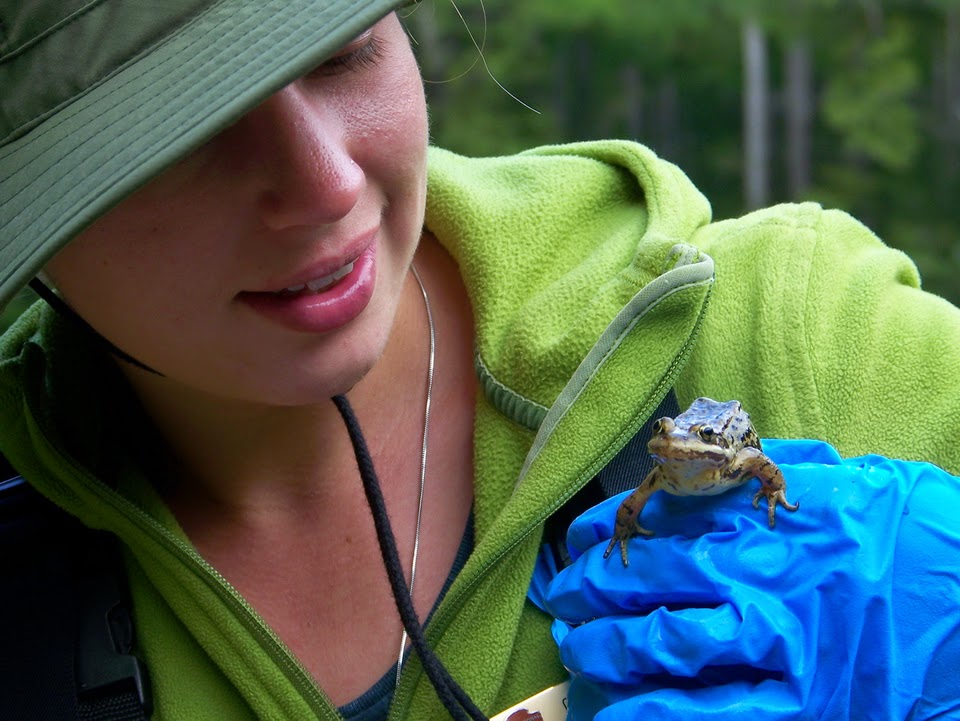
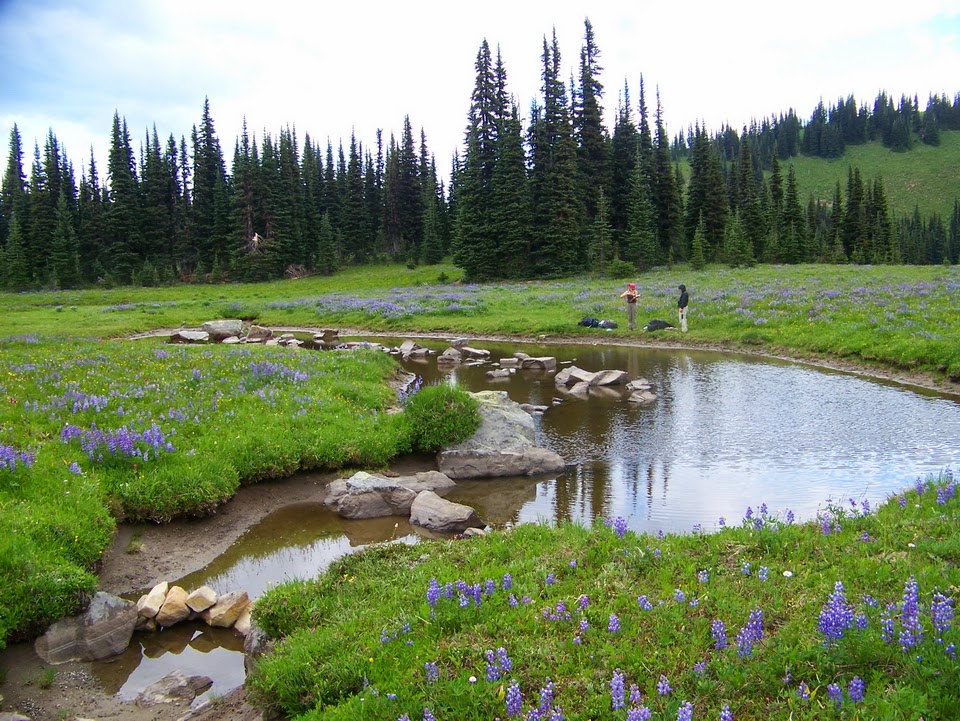
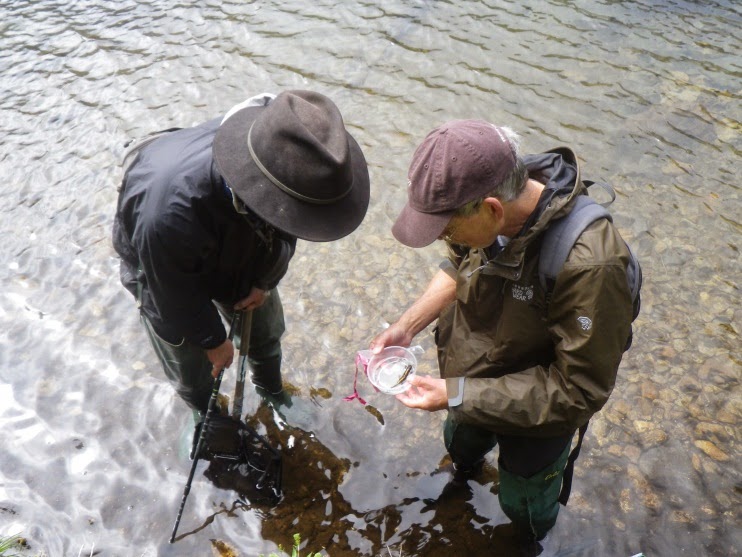
Following up on yesterday's post about volunteers helping to understand the effects of climate change, here are some photos of our Citizen Science Amphibian Survey program from over the years. This intrepid group of volunteers, under the leadership of an intern hired through the Student Conservation Association, head out into the backcountry to census populations of frogs and salamanders in wilderness lakes and ponds all over the park. We know that amphibians are especially sensitive to environmental conditions including pollution and climate change, so it's helpful to park managers to know their baseline populations and how they change over time. These are data we simply wouldn't have without volunteers, and our ability to protect Mount Rainier would suffer greatly as a consequence.
In 2014, 25 volunteers contributed 873 hours of service exploring 31 wetland, ponds, and lakes, gathering amphibian, dragonfly, and bathymetric data.
If this sounds like a way you'd like to help, pop over to page on volunteer.gov and fill out an application. Keep in mind that this is a job that doesn't begin until the snow melts at high elevations, usually in July, and our coordinator doesn't come on duty until late June. Don't be alarmed if May rolls around and you haven't heard from anyone yet. Be aware, too, that this is job for the physically fit, as you may find yourself trekking cross-country to camp at research sites for a day or two. The rewards, on the other hand, are tremendous. Just check out these photos of your new "office."








Thursday, April 30, 2009
DRAFT Interpretive Training Schedule
Hey volunteers, we've started nailing down the schedule for the Interpretive Training, but let me emphasize that this remains a DRAFT. Each day has a theme of sorts, and I've broken the days into morning (AM) and afternoon (PM).
Tues 6/2 - Day 1: Climate Change
AM: Introduction, Paperwork and Orientation
PM: Speaker - Climate Change
Wed 6/3 - Day 2: Geology
AM: Presentation & Demo
PM: Field Trip
Thur 6/4 - Day 3: Ecology
AM: Presentation
PM: Demo's
Fri 6/5 - Day 4: History & Culture
AM: Presentation & Field Trip
PM: Demo
Sat 6/6 - Day 5: Informal Interp, Living History & Ecology
AM: Technique, Practice & Demo
PM Walk & Presentation
The tenitive plan is for the day to start at 9:00 AM, breaking for an hour lunch at 12:00 PM and ending at 4:00 PM. Remeber, this schedule is only a DRAFT is is subject to change.
Saturday, July 27, 2013
Tracking montane wildflowers to unlock the secrets of our changing world
This article comes from Janneke Hille Riis Lambers of the University of Washington:
To residents of western Washington, the beginning of the high mountain hiking season doesn’t start until June or July – as snow is cleared or disappears from mountain roads and hiking trails. For example, the roads to the Sunrise Visitor Center and Mowich Lake at Mt. Rainier National Park only recently opened this year (early July), and some of the beautiful hikes from those locations still require hiking over snow.
As an environmental scientist based at University of Washington, this time of year means a flurry of logistical planning and coordination, as my students and I continue our studies on the relationships between climate, tree growth, and wildflowers at Mt. Rainier National Park. Although 1-3 feet of snow remains at some of our field sites above Paradise Meadows, the Avalanche lily has already emerged and is even setting seed at our lower elevation study sites near Reflection Lakes. If we’re not careful, we can miss the entire three-week flowering season of this beautiful species, which emerges directly from the melting snow sometime between mid-July and mid-August (depending on how late in summer the heavy snowpack melts out that year).
Exactly when the Avalanche lily blooms is significant for a number of reasons. Aesthetically, it is one of the most charismatic plant species in the meadows of Mt. Rainier (in our opinion), and a true sign that summer is coming to the high mountains. But the phenology of this species is also an important indicator of a changing climate. Phenology is the seasonal timing of life events, like a plant’s flowering and seedset, or an animal’s migration, reproduction and hibernation. And phenology is frequently directly tied to climate.
Although you wouldn’t know it from some of the cool and wet springs we’ve experienced in western Washington in the last 2-3 years, the Pacific Northwest has warmed by an average of 0.83°C in the last 100 years (according to the Climate Impacts Group at University of Washington). Our climate is changing, and the timing of the seasons is changing with it. Climate scientists tell us we should expect even more warming in the next 100 years.
This warming trend has implications for the phenology of plants and animals in Washington. Plants will likely emerge and flower earlier in the spring, and animals may also migrate or reproduce earlier in the season. This could mean that farmers markets will offer asparagus and cherries earlier in spring as the growing season advances. Our western Washington forests may become more productive as the growing season extends, but only where there is plenty of moisture and where pests (like the mountain pine beetle) or forest fires don’t also increase in frequency and abundance.
At Mt. Rainier National Park, the Avalanche lily (and other high mountain plant species) will likely emerge earlier as snow melt advances, and eating huckleberries at high elevations may also be possible earlier in the summer. Some of these changes may be problematic: the insects that pollinate Avalanche lilies and the bears that count on huckleberries for food may be in trouble if they can’t modify their behavior to keep track of their food resources.
To better understand the link between climate and the phenology of individual species — including the Avalanche lily — scientists like me have to take detailed notes on many individual plants. For example, my graduate student Elli Theobald has been returning to the same plants growing in Mt. Rainier National Park every year since 2010 so she can carefully track when this species, and other wildflowers, first emerges from the ground, flowers, and set seed. Eventually, she will compare those data to the local climate each plant experienced in that year (which we measure with microclimate sensors). The more data she and scientists like us have, the more we know and the better we can anticipate change, both in our local parks as well as regionally.
Collecting such data is time-consuming and difficult to get in the volumes scientists need for analysis. Scientists therefore often turn to the general public for help. A recently founded citizen science program out of my lab (MeadoWatch) is engaging in two such efforts at Mt. Rainier National Park. We have 60 volunteers lined up for ‘wildflower hikes’ throughout the summer, during which they will observe and note the timing of flowering for ten wildflower species. Our hikes are all full for this summer, but check out our website next spring if you want to participate in summer of 2014. If you are eager to participate in scientific research this year, we are also asking visitors like you to share any wildflower pictures you have taken within Mt. Rainier National Park with us. As long as we know exactly when and where each picture was taken (e.g. from date-stamps and geo-tags), it can serve as an ‘observation’ of phenology of whatever species you photographed. Together, these data sources will allow us to understand how the wildflower meadows come alive after snowmelt and change hue over the course of the summer as different wildflower species bloom.
You can join this effort by uploading any wildflower pictures you’ve taken within the park to our project website on iNaturlist.org (see our project website for more details). Additionally, if you are interested in continuing to monitor phenology in your own backyard when you get back from your visit to Mt. Rainier, consider working with our partner organization, the USA National Phenology Network, which engages volunteers throughout the country to monitor the phenology of nearly 900 plant and animal species through Nature's Notebook.
Regardless of which of these programs you engage in, your observations, along with many others, will have meaningful impact. They will allow scientists like me and my graduate student Elli Theobald to continue our quest for scientific discovery. Additionally, your data will also allow us to make very real, practical resource management recommendations to Mt. Rainier National Park on activities which are linked to the timing of the wildflower season (e.g. peak visitation, plant restoration activities). We hope you will participate!
Monday, November 17, 2008
Climate, Flooding, and Mount Rainier
Here's a great article on WTA's Signposts Blog about the recent and future flooding at Mount Rainier and its relation to the ongoing process of global climate change. Interesting reading, as it touches not only on flooding but on other processes like changing ecosystems.
While the damage is likely nowhere near what hit the park in in 2006, it does remind us that flooding events continue to frequently wash down the valleys of the Cascades.... Meanwhile, the News Tribune reports that alpine meadows in Mount Rainier National Park are disappearing. Scientists have found that, since 1930, new forests have been encroaching on the spectacular wildflower meadows (which make up about 23 percent of the park's land area). The culprits? Climate change, decreasing snow pack, and lack of wildfires all play a role.
Friday, November 30, 2007
San Diego bound
 I'll be off to San Diego next week to participate in the Pacific West and Alaska regional superinten-dent's conference. The conference runs Tuesday through Thursday, with discussions about issues facing superintendents throughout the region, including global climate change, volunteerism, public partnerships, outreach and recruitment, new technologies, and the Service's Centennial Initiative. I've been invited to participate in a panel discussion on Wednesday morning, talking about strategies for connecting members of the public with their national parks, especially youth. I'll be joined by Saul Weisburg of the North Cascades Institute, Mandy Vance from WildLink, near Yosemite, and Michael Richardson from the James P. Beckwourth Mountain Club in Denver. These people represent very successful partnership with other national parks, and even though our own partnership with SCA has been tremendously successful this past year, I still feel a bit like the new kid on the block! I'm very much looking forward to hearing what the others have to say, and learning from their experience, as well as attending some of the other conference sessions during the day: "The Special Meaning of National Parks," by Dayton Duncan; "Connecting People to Nature: The National Park Service Role," by Richard Louv; and, in the afternoon, three great options for what unfortunately are concurrent sessions: "Programs that Connect Youth and Communities to Parks," "Technology Tools for Connecting People to Parks and Parks to People," and "Cultivating Park Stewardship through Volunteerism."
Tuesday is a bonus day: since I'll already be there, I get to listen in on the discussions of climate change and the Centennial Initiative, and look forward to bringing insights on those topics back to the interpretive staff here at Rainier. With our glaciers melting at an accelerating rate, and our rivers filling up with glacial debris, changing course, and flooding their banks, that's an extremely relevant issue for us here.
Meanwhile, I've spent part of the past week preparing for the conference, including creating a poster about our flood recovery efforts to display. I've included a thumbnail version that you can click to see at larger size (not full-size--it's 36x48" at 300dpi!!). It's an interesting challenge, to boil down a full year of effort, involving permanent, seasonal, and volunteer staff and numerous partners, into a poster that isn't too complicated or wordy, and still has enough visual flair to catch people's interest. You can judge for yourself how successful I was.
In other news, check out Washington's National Park Fund's new website (see the previous blog entry for details), and don't miss their links to SCA's Final Report for 2007 and a Flickr website with tons of great pictures from around Mount Rainier. And finally, note that there is now 15" of snow on the ground at Longmire, and 34" at Paradise. The trees through my window here at Longmire are blanketed with snow and very beautiful. Dust off your skis and snowshoes, winter's a-comin'!
- Kevin Bacher, Volunteer Program Manager
Friday, July 3, 2015
Volunteer Newsletter: July 2015
June Highlights

