Showing posts with label Olympic National Park. Show all posts

Saturday, April 27, 2013

Teaming Up

When Carol and Jim Miltimore were hiking at South Beach (Olympic National Park), they discovered a tangle of ropes and net which had washed in on the tide. Assisting Olympic Volunteers Walt, Conrad and unnamed others over the weekend, they removed a substantial quantity of beach debris to a spot for later pickup. Volunteers lend a hand even when they're not in their "home" Park!


Monday, November 30, 2009

The goal: Nearly $350,000 for parks

The goal: Nearly $350,000 for parks The News Tribune

Washington's National Park Fund seeks to raise $350,000 to support projects at Mount Rainier, North Cascades, and Olympic National Parks, including youth programs, outreach, and volunteerism. For the person who has everything, consider supporting a good cause on their behalf!

Monday, October 5, 2009

Volunteers urgently needed to help move Olympic NP Greenhouse

As we move into our fall season, volunteer opportunities at Mount Rainier are rapidly dwindling. Not so for some of our lower-elevation neighbors, however! I got a call from Maggie Tyler this morning, my volunteer coordinator counterpart at Olympic National Park, which, as you know is almost as extraordinary a park as Mount Rainier!

All kidding aside, Olympic (and Klondike Goldrush National Historical Park as well as the non-NPS sites in the Puget Sound region) are great places to contribute when our own trails are covered by snow. And the need for volunteers at these sites can be just as great as our own.

Here, then, is a great introductory volunteer opportunity at Olympic that meets a need as urgent as our own planting program at Paradise has been these last few weeks:

Olympic National Park will be hosting an open house on October 22 at our new facility at Robin Hill Park, located in Sequim, Washington. To get ready for this long awaited event we will be preparing our plants and supplies for the move over the next few weeks. We are looking for interested volunteers to move our greenhouse operation from our old location in Port Angeles to our new location in Robin Hill Park. We will be holding an orientation for all interested on October 7th at 10:00 A.M. at our current greenhouse in Port Angeles. Anyone interested in attending can contact me for directions either at the phone number below or at my email address, maggie_tyler@nps.gov. Volunteers should dress for any weather since they may be working out doors.

I know the 7th is short turn around time, but we will be very busy over the next few weeks. If folks can't join us on the 7th, they can still call me for additional times and dates they are available. If we have someone working in the greenhouse, they are welcome to join us.

Friday, April 10, 2009

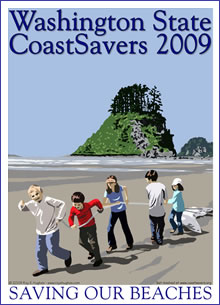
Washington Coastal Cleanup at Olympic, April 18

Summer is rapidly coming--but don't look at the weather forecast! Looks like we may get still more snow above 1000' on Easter Sunday. At least, this time of year it melts rapidly. How does Longmire compare to average? We have 50 inches on the ground as of this morning, compared to an average of 7 inches for this date. That's either 700% of average, which sounds terrifying, or 43 inches over normal, which realistically is only a few extra weeks of good melting weather.

But clearly, we aren't planting at Longmire yet! The Mount Rainier National Park Associates will join us on April 25th for trail work, and are looking for volunteers to help, but that will almost certainly be at a lower elevation location such as Carbon River or Westside Road.

Meanwhile, you can't get much lower than sea level... so consider taking a jaunt across the Penninsula and joining Olympic National Park for their annual Coastal Cleanup Day on April 18! Here's the summary from National Parks Conservation Association representative David Graves:

It is time for this year's Washington Coastal Cleanup on Saturday, April 18, 2009. NPCA will once again be leading a volunteer group to the Olympic National Park for a day of cleaning up the coast and camping (if you want!). If you would like to camp, we will be camping at the Kalaloch Campground in the southwest corner of Olympic National Park (for free!) on Friday, April 17th and participating in the cleanup on the 18th. We will finish the cleanup in the afternoon, which will be followed by a cookout with all the volunteers. Afterwards, you are welcome to head home or stay another night, free of charge, at the beautiful beach side campground at Kalaloch. Last year we had no rain and a beautiful day on the beach. However, the year before we had non-stop rain, so come prepared for all types of weather! To join the group and get the details, please contact David at dgraves@npca.org or (206) 902-1444, ext.25.

See also the Washington Coastsavers website at http://www.coastsavers.org/.

Friday, March 27, 2009

Serve America, Olympic newsletter, Family Fun, and Earth Hour

Here are several items that may be of current interest to our readers:

  • I've been tracking the House of Representatives' GIVE Act, which passed last week. The Senate has now overwhelmingly passed its version of the bill, the Edward M. Kennedy Serve America Act. The two bills will now go to a conference committee for reconciliation. Given how strongly both bills passed, the final bill will likely end up at the White House soon for the President's signature.
  • The March edition of the Olympic National Park Newsletter is now online at http://www.nps.gov/olym/parknews/park-newsletter-march-2009.htm. Check it out for news and photos, including updates on Elwha construction projects, park visitation and more; recent honor awards for two Olympic NP rangers; and upcoming events, including National Park Week celebrations and more.
  • A month ago, I mentioned an article in the recent issue of Family Fun magazine, talking about volunteer opportunities with family. Author Melissa Gaskill has now posted a copy of the article on her blog, which you can read here.
  • And finally, a "volunteer" opportunity you can carry out at home, sent to me by Acting Deputy Superintendent Roger Andrascik, who says:

    Earth Hour: Join an effort that recognizes the importance of one of Mount Rainier’s special resources—the dark night sky. Flick off your light switches during a worldwide event, Earth Hour, from 8:30 to 9:30 p.m. March 28. More than 500 cities in approximately 75 countries have pledged to participate in the World Wildlife Fund’s one hour of solidarity to combat global warming. Earth Hour, which began in Sydney, Australia, in 2007, is being presented as an election in which you can "Vote Earth" by switching off non-essential power; election results will be presented at the Global Climate Change Conference in Copenhagen later this year. Mount Rainier National Park votes every day for dark night skies—undisturbed by light and air pollution—because those skies have natural, cultural, and scenic importance. If current light pollution trends continue, there will be almost no dark skies left in the contiguous United States by 2025. So, register for Earth Hour at www.earthhour.org. For more on night skies and the NPS Natural Lightscape program, see the http://www.nature.nps.gov/air/lightscapes/index.cfm.

Thursday, July 3, 2008

Seminars of interest to volunteers

Along with volunteer projects, there are many opportunities coming up for volunteers (or anyone else interested in issues relating to national parks) to learn or participate in seminars, discussions, or classes. Here's a sampling from my e-mail in-box:

July 10: Climate Change in National Parks Web-seminar SeriesThe National Park Service is pleased to present a series of web-based seminars on climate change offered bi-monthly starting July 10th, 2008. These web seminars will be facilitated by Dr. Leigh Welling, NPS Climate Change Coordinator. This series is intended to help connect NPS employees, volunteers, and partners with scientists and experts in the field of climate change research. Our goal is to provide a Service-wide forum where researchers can share credible, up-to-date information and research materials about the impacts of changing climate in national parks and where NPS employees, volunteers, and partners can participate in a discussion with the researcher about climate change in National Parks. Presentations will begin at 2pm EDT and last about 60 minutes (20-30 minute presentation and 20-30 minutes for questions). To participate, register at the web seminar website using the link provided below:

https://www.eventbuilder.com/event_desc.asp?p_event=y9f1a14c&eventid=y9f1a14c&gateid=ebc

Presentations and other related materials should be available prior to each event on the climate change forum web-site http://nrpcsharepoint/climatechange/default.aspx, enabling anybody to access and download them in advance and follow along by phone if internet connectivity isn’t available or reliable. This site will also contain an archive and recordings of previous presentations. [Note: I believe this is an internal National Park Service website and not accessible outside our intranet. I think the presentation itself will be accessible outside our network, but if not, volunteers will be welcome to join us at Mount Rainier to participate.]

Dr. Lisa Graumlich's, Director of the School of Natural Resources at the University of Arizona, will open the webinar series on July 10th at 2pm EDT with her talk on The Impacts of Climate Change on Parks, Protected Areas, and Cultural Sites. Dr. Graumlich's position as Director of the School of Natural Resources at the University of Arizona allows her to combine her career-long interest in mountain regions with her concerns for sustainability. As a researcher, she uses tree-ring records to investigate how climate variation affects forests. The focus of her work is treeline, the boundary between forest and tundra on high mountains. Documenting and understanding changes at treeline is particularly interesting because, if projections of future global warming are correct, treeline is likely to be one of the first natural ecosystems to register the change in climate. Her work in the Sierra Nevada documented how climate events of the past 3500 years caused rapid change in the structure of treeline forests.

Future presentations are planned for Thursday, September 11th, with Dr. Max Boykoff, Research Fellow at the Oxford University Centre for the Environment, and on Thursday, November 13th with Dr. Nathan Stephenson, Director of USGS's Sierra Nevada Global Change Research Program.

For more information about this webinar series contact: Leigh_Welling@nps.gov or John_Morris@nps.gov. Thanks for your interest; we look forward to having you join us.


July 12: Northwest Science Writers Summer Event--Research in Olympic National ParkNSWA is excited to announce a summer NSWA Event: A day in the Olympics. More information to come soon, but mark the day on your calendar. More info and photos on the NSWA website: http://nwscience.org/events/08/onp

* Spend Saturday July 12 in the Olympics with wildlife experts and scientists
* Learn about ongoing research in Olympic National Park, including research related to the slated Elwha River dam removal
* Hike Hurricane Hill
* Enjoy a barbecue dinner in the foothills of the Olympics
* NSWA Members: $25, Nonmembers: $30—NSWA van from Seattle available, or drive yourself
* Seating for for the talks is limited; guests and families welcome on the hike and barbecue
* RSVP ASAP to NSWA Treasurer Deanna Frost deafrost@yahoo.com (Subject: ONP Event)
* Questions? Event Organizer Stephen Hart hart@nasw.org (Subject: ONP Event)

We’re still nailing down specifics—and plans could change depending on weather—but here’s the tentative schedule (appropriate breaks not listed):
7:30 am—NSWA van leaves Seattle for Port Angeles
10:30 am—van arrives in Port Angeles
11:00 am—Meet at Olympic National Park headquarters to hear about research in the park. Jerry Freilich, Ph.D., Research Coordinator, Olympic National Park and Coordinator, North Coast & Cascades Research Learning Network, will give us an overview of research going on in the park—some 60 projects—and introduce specific projects and researchers. Jerry can also help with contacts on other projects going on in the park. Speakers to be announced. Examples include:
* The All Taxa Biotic Inventory in the Elwha River valley, part of the preparation for the removal to two dams on the river to restore salmon runs
* Research on the Olympic Marmot, an endemic species
* Reintroduction of the fisher, a large weasel that disappeared from Washington in the late 1800s/early 1900s because of overtrapping and habitat loss
* The Plate Boundary Observatory, a large, NSF-funded and nationwide (but mostly Western) project using specialized GPS monitors--capable of accuracies as close as 1-2 millimeters--to measure the movement of the earth's tectonic plates
12:30 pm—Eat (bring your own sack) lunch while driving to Glines Canyon dam, one of two to be removed.
1:30-4 pm—Drive to Hurricane Ridge for a casual guided hike to Hurricane Hill. Expect great views of mountains and wildlife.
5:00 pm—Drive down the hill for a BBQ dinner at Stephen Hart's home in the foothills of the Olympics.
5:30 - 8:30 pm—Feast on local salmon, burgers, hot dogs, local organic veggies and fruit and delicious homemade desserts.
8:30 pm—Leave barbecue for the ferry and Seattle.


September 3: The Way In: The Future of Access to Northwest National ParksWednesday, September 3rd
6:00 pm - 8:00 pm
University of Washington
Kane Hall, Room 110
Filmed by WTV

The National Parks Conservation Association (NPCA) is planning to host a panel discussion on global climate change and how it will affect our national parks, especially Olympic, Mount Rainier, and North Cascades National Parks. This panel will focus on the effect of climate change on these parks and the future of access to them.

The floods and windstorms of 2006 were just the latest storm events to ravage Washington’s public lands. Given the high likelihood that future storms will cause similar damage, NPCA is facilitating a discussion on how the federal government can best sustain long term access to places such as Mount Rainier that make sense from an economic and ecological standpoint. We propose a panel discussion open to the public that would include experts in climate change, outdoor recreation, economics, wildlife and roads and trail construction, among others.
Led by Congressman Jay Inslee, we plan to hold this panel discussion at the University of Washington on September 3rd.

This event is co-hosted by other organizations from the Washington Parks and Forest Coalition, including Washington Trails Association, the Student Conservation Association, The Mountaineers, and Washington's National Park Fund.

Confirmed Participants:
Moderator – Professor Michael Robinson-Dorn, Director Berman Environmental Law Clinic, University of Washington Law School – mjrd@u.washington.edu
Representative Jay Inslee - Kiersten Hutchins, Scheduler - kiersten.hutchins@mail.house.gov (invited, but not completely confirmed)
Dr. David Louter – History Program Manager, Pacific West Region, National Park Service - David_louter@nps.gov
Jonathan B. Jarvis – Regional Director, Pacific West Region, Nation Park Service - Jon_jarvis@nps.gov
Dr. Clifford F. Mass – Department of Atmospheric Sciences, University of Washington - cliff@atmos.washington.edu
Michael Case – Research Scientist, WWF Global Climate Change Programme - michael.case@wwfus.org
Paula Swedeen, Ph.D. – Ecological Economist, Swedeen Consulting – burdeen11@comcast.net
Clara Conner - Division Engineer, Western Federal Lands Division, Federal Highway Administration - Clara.Conner@fhwa.dot.gov

Wednesday, April 30, 2008

New news and previews of coming events

April and May are always busy months for our volunteer program. I'm getting at least half a dozen calls and e-mails per day from people with questions about volunteering, and we're busy planning projects and training for the coming season. Here's where we stand:

New Volunteers: I've received dozens of calls and e-mails in the past two weeks while I've been traveling from people interested in joining our volunteer program. Thank you all for your interest! I'm a bit overwhelmed at the moment getting caught up from being away, but responding to your inquiries is high on my priority list. Please be patient, I intend to respond to each of you, hopefully within the next week. This is a good place to remind you, too, that I would be extremely grateful for some help keeping up with the start-of-season flood of paperwork and correspondence related to new volunteers. Some of it (the correspondence especially) could even be done remotely. If you'd like to help, send me an e-mail.

Projects: Meanwhile, we're making progress on a project calendar for the summer. My partner on the SCA side, Jill Baum, will be sending me a list of upcoming projects, which I will post here on this blog. We have few specific dates yet, but hope to have them soon. Most of the work will begin in mid June, with a few earlier projects; you can, for sure, set aside June 7, which is National Trails Day and will have a bunch of projects scheduled.

Training: We're also closing in on a training schedule. I have a tentative schedule, at least, for our beginning-of-season interpretation training, our volunteer program management training, and our Conservation Corps training. Volunteers are welcome to participate in any or all of that. I'll post those tentative calendars later today or tomorrow, so stay tuned and watch for it in a later blog entry.

Surveys: Don't worry, I haven't forgotten to get back to you with the results of the volunteer survey. It has been such a gold mine of information that it's taken some time to compile. I'm about halfway through preparing a PowerPoint/PDF summary of the key insights we've gleaned from the survey, and will share that with you, along with the raw data, as soon as I get it finished.

Representing Mount Rainier: As we announced recently, Mount Rainier National Park has received the George B. Hartzog Jr. Award for Outstanding Volunteer Service. Superintendent Dave Uberuaga and I will be traveling back to Washington D.C. next week with volunteers Eva Meassick and George Coulbourn to receive the award on behalf of our volunteer program. Thank you to Eva and George for agreeing to represent us at this prestigious event! It will be a luncheon ceremony at noon on May 8th, attended by the Director of the National Park Service.

Eva and George are both patrol rangers in the Carbon River/Sunrise areas of the park. Both have been volunteering for years and have received our Superintendent's Award for Lifetime Achievement. Eva has passed the 10,000 hour mark for volunteer service since 1987, while George is closing in on 5,000 hours since 1997.

More from the EarthVision Summit: The EarthVision Summit I attended last week, sponsored by the Student Conservation Association near Washington D.C., was incredibly energizing. More than 400 youth attended, and their commitment to service on behalf of the environment was inspiring. I'm still sorting through my own pictures, but meanwhile, if you're interested, you can find loads of images, videos, and stories at SCA's Conservation Nation blog.

In the News: Also out there in cyberspace: The Washington Trails Association now has a YouTube page; spring opening is a struggle at Olympic National Park (no surprise, since we're dealing with lots of lingering snow issues ourself); and Mike Gauthier has posted a "year in review" summary for the Mount Rainier climbing program. I hear also through the grapevine that a citizen climber on our mountain will be receiving a Valor Award next week for help in saving the lives of a couple of other climbers. I'll try to get more details on this and share it with you. Meanwhile, Mount Rainier is one of many national parks nationwide that will receive Centennial Initiative funding to help improve the park; the park is still accepting input from the public about proposed repairs to the Wonderland Trail near Carbon River; and a news website in Massachusetts (!) listed WTA-led volunteer projects at Mount Rainier as one of six examples of Earth Day activities nationwide.

That's all for now; I'll get those training calendars, project lists, and survey summaries posted as soon as I receive them.

Thursday, April 24, 2008

How to get involved

The Seattle Times had a really nice editorial today about our volunteer program and the awards we and our volunteers have received recently. Here's the lowdown on how you can help:

  • Check out the list of current volunteer opportunities in the right-hand column. Most of these are long-term or recurring volunteer projects.

  • Watch our calendar of volunteer projects on the website of our partner, the Student Conservation Association. These are mostly short-term (one to five day) projects. Nothing is posted yet, and not much is going on right now because of an abundance of spring snow, but we'll start posting projects within the next month. You can also follow all of our volunteer program activities on our master calendar in the right-hand column of this page.

  • If you'd like to get on our mailing list, just send me an e-mail. I hope to get our our first newsletter of the season within the next week or two, and after that, I'll be sending out regular updates as projects and training opportunities are announced. You can also watch for news on this blog, of course.

  • Volunteer with our (award-winning) partners! The Washington Trails Association is already listing trails projects that you can sign up for, for instance; and Olympic National Park, with more low-elevation terrain, has projects underway. In addition, you can get involved through the National Parks Conservation Association, Washington's National Park Fund, or The Mountaineers.
See you soon out on the trails!

Saturday, April 19, 2008

Washington Coast Cleanup Day at Olympic National Park

From the Northwest Interpretive Association, for those of you near Olympic National Park:

Washington Coast Cleanup Day is Almost Upon Us - Join Us April 26th! To celebrate Earth Day this year, we're hoping about 1000 people will come out to Washington's Pacific Coast to help remove tons of marine debris from our state's beaches. It's going to be a great day, and I hope to see lots of NWIA people and partners out there helping. Visit the Washington CoastSavers website to signup for your favorite beach: www.coastsavers.org/washington .

Friday, March 28, 2008

State’s badly damaged national parks, forests need more help from volunteers

From today's News Tribune, a great summary of the flood damage that still remains in Washington's National Parks and Forests:

Why do our public lands need help? I can give you $65.9 million worth of reasons. That’s the current storm damage estimate for Mount Rainier, Olympic and North Cascades national parks, plus Gifford Pinchot, Mount Baker-Snoqualmie and Olympic national forests. Simply put, windstorms and rainstorms have battered public lands around the Puget Sound in the past two years. Consider these examples:
Check out the News Tribune's website for the full article. If you'd like to help out, here are links to the websites of the volunteer programs mentioned in the article:

Mount Rainier National Park
Olympic National Park
North Cascades National Park
Baker-Snoqualmie National Forest
Gifford Pinchot National Forest

Olympic National Forest
Washington Trails Association

Every one of us still needs help cleaning up flood damage, including Mount Rainier. Consider planning a statewide tour of volunteer projects... See the Northwest! Volunteer in our National Parks and Forests!

Saturday, March 15, 2008

Parks assess damage after winter storms

This on HeraldNet today, about ongoing flood recovery efforts, including contributions by volunteers, at both Olympic and Mount Rainier National Parks:

"Winter storms have battered the Pacific Northwest's national parks each of the past two years, with damages in the millions of dollars. After last year's massive repairs to Mount Rainier National Park, the latest victim is Olympic National Park, where craggy alpine peaks, forested lowlands and miles of Pacific coast offer visitors the trifecta of a wilderness experience.

"Volunteer crews are making the park the focus of their efforts this year -- though workers at Mount Rainier and North Cascades national parks also are furiously repairing fractures to roads and trails left from winter storms. It all means that visitors to the region's parks once again will have to sidestep some storm damage when planning summer vacations."

Update: See also "Washington's national parks scrambling to repair storm-damaged trails, roads for vacationers" in the March 18 Seattle Times.

Wednesday, March 12, 2008

You're Invited: Taking the Parks by Storm!

Community Support for Restoring Washington's Treasures

A series of storms battered the Pacific Northwest during the fall and winter of 2006 and 2007, bringing major flooding, hurricane-force winds and heavy snows. Washington’s national parks - Mount Rainier, Olympic, and North Cascades - were severely impacted.

The Northwest Storm Recovery Coalition is sponsoring "Taking the Parks by Storm: Community Support for Restoring Washington's Treasures" on Monday, March 17, 2008, to bring members of Congress and representatives from the three parks together to describe the storms' impacts, the current state of repairs at the parks, and how upcoming visits to the park may be affected. Also, this event will provide attendees an opportunity to ask questions, visit with representatives from each park to learn about volunteer activities, and to find out how they can be further involved.

When:
Monday, March 17th, 6:30PM-8:30 PM

Where:
Seattle REI Flagship
222 Yale Ave N
Seattle, WA 98109

The Northwest Storm Recovery Coalition, which includes the National Parks Conservation Association, the Student Conservation Association, Washington’s National Park Fund, and Washington Trails Association, works to help support, repair, and restore affected parks and other public lands.

For more information, contact: David Graves at dgraves@npca.org or (206) 903-1444, x25.

Monday, January 7, 2008

Things at Rainier looking up!

From the Northwest Storm Recovery Coalition's blog:

After massive storms last winter, the National Park Service (NPS) reports things are returning to normal at Mount Rainier, Washington's icon national park. This summer, the Park Service expects hikers to be able to complete the entire wonderland route around the mountain. The historic trail had been damaged in approximately 16 places, so some reroutes were required. Also, the NPS believes damage to state route 123 on the park's east side will be repaired by the start of the summer season, allowing visitors to enter on one side of the park and exit at another. Finally, the NPS will soon take public comments on what to do with the carbon river road in the park's northwest corner. The Carbon river road has washed out repeatedly and the NPS is looking for suggestions on a sustainable long term public access solution.

Monday, December 17, 2007

Our roads need a fix

From the blog of the Northwest Interpretive Association:

"....Olympic National Park faired no better. The popular Hurricane Ridge road is closed due to shoulder damage - from lessons learned from last year's storm and Mt Rainier, a road may appear drivable but the shoulder may be undercut. Also closed because of the storm are the Heart o' the Hills campground, the Sol Duc road, the Hoh road and the Quinault roads.

"Again, the call for volunteers goes out to the northwest. Such a great response was made last year to get Mt Rainier re-opened, that we hope this year will also see people pitching in for public lands."

Friday, December 14, 2007

Surveying the damage

The Washington Trails Association's blog, "The Signpost," has a good roundup of the flood damage reports from, as writer Andrew Engelson says, "our annual 100-year storm." A short exerpt:

"In terms of mountain roads and trails, the Olympics were perhaps hardest hit. The latest from Olympic National Park and Olympic National Forest is that the Quinault area has suffered extensive damage. Most of the roads in the area are closed due to washouts and numerous blowdowns, including Graves Creek, the North Shore Quinault Road, and much of the South Shore Quinault Road. According to Pete Urban, with Olympic National Forest, just about every trail in the vicinity of Lake Quinault Lodge has many, many blown-down trees."

Thursday, December 13, 2007

Field Notes

Here's a random assortment of current news and links related to volunteering:

Flood Recovery: Here's a great story in The Olympian about volunteer efforts in response to the flooding around Chehalis, including information about how you can help through the Volunteer Center of Lewis, Mason, and Thurston Counties. See also this report, from The Oregonian.

Olympic Flooding: Olympic National Park now has a page for reporting the current status of roads and trails in the park, which also includes some impressive photos of their flood damage. It's all eerily familiar to those of us at Rainier who went through this last winter. I spoke with Maggie Tyler, the volunteer coordinator there, a couple of days ago. They have many roads washed out or undermined, a lot of their trails are buried by snow and so we won't know until spring how much they were affected, hundreds of trees came down, the entrance station at Hoh Rainforest was flooded, and at the peak of the flood, the Elwah River came just barely short of overflowing its dam. Current details are in the December 13 edition of the National Park Service's Morning Report.

Flood Science: Last winter, volunteer Scott Beason and others surveyed the effects of the flooding on Mount Rainier National Park. Along with park geomorphologist Paul Kennard, he has now published his final report on what he learned, and it's fascinating reading. Right-click this link to download a copy of "Environmental and ecological implications of aggradation in braided rivers at Mount Rainier National Park."

Next Summer at Rainier: In other news, planning for next summer's volunteer program continues well. Jill Baum and I have met with several park supervisors, and we're all excited about next year's program, which will be similar to this year's but with volunteer coordinators "embedded" in some of the park's key programs. We've gotten good feedback, suggestions, and questions, and are fine-tuning plans, even as we begin hiring for next summer's Mount Rainier Recovery Corps! If you know of anyone who might be interested in applying, send them our way! We're also working hard on putting together an exciting schedule of volunteer training opportunities in May and June, including NPS volunteer management, Leave No Trace, Risk Management, CPR, Wilderness First Aid, work skills, and NPS Orientation. Should be a fun summer!

Friday, December 7, 2007

Floods roundup

I'm back from San Diego, which is an odd place to be, in sunny 70 degree weather, when your home state is drowning under floods. It's strange to turn on CNN and see the lead story covering places just an hour from your home. Lots of folks have called or e-mailed me asking about the status of Mount Rainier National Park, so I apologize for being out of touch at this critical time. Here's a roundup of what's happened and where we stand.

Mount Rainier National Park seems to be fine. That could still change, as many wilder parts of the park are inaccessible at the moment due to winter snow, and we could find pockets of devastation when the snow melts in the spring. But so far, so good: all of our road and levee repairs held up well through the storm, with only minor erosion and some trees down. This storm was not nearly as bad as the one a year ago... for us at Mount Rainier. It was, of course, devastating for people in Chehalis, Tillamook, and other areas where the storm hit more directly, including Olympic National Park.

Storm stats: Acting Superintendent Roger Andrascik wrote on Tuesday morning: "The Nisqually River at National appears to have crested at 2200 hours Monday 12/3/07 at 11.37', below the predicted 11.8' and well below the historic 12.8' in 2006." Flood stage is 10 feet. Here's a link to the current streamflow data for the Nisqually River, and to the left you'll see a chart for the period of the storm. We got about 6 inches of rain in a little over 24 hours, far less than the 18 inches we got in 36 hours last year. Looks like maximum stream flow was about 9,480 cubic feet per second, compared with an average discharge of around 12,000 cfs on November 6, 2006. At 2pm on December 2nd (and for several hours before and after), Camp Muir was getting 95 mph sustained winds with gusts to 111 mph, before the wind station gave out that night.

Storm reports: Here's a summary report from the NPS Morning Report for December 5:

Mount Rainier – The park received 3.7 inches of rain in a 24-hour period on December 3rd. Despite continuous heavy rainfall throughout the park during the day and throughout the night, no significant damage was reported. Some flooding, mudslides, and runoff overtopping roadways occurred in local areas outside the park, causing hazardous driving conditions getting to and from Mount Rainier. An interdivisional planning team put contingency plans into effect in the event that the heavy rainfall began to affect the safety of visitors or employees. Non-essential employees were provided several hours of administrative leave in the afternoon to assist them in getting home to their families safely during daylight hours. The Nisqually River reached flood stage around 10 a.m. and continued to rise until it crested at 11.37 feet later that evening. As a comparison, the devastating flooding that occurred in the park a year earlier (November 6, 2006) crested at 12.8 ft. Roadway repairs, culvert improvements, and stream reinforcements constructed following the 2006 flood all survived this most recent event and performed as designed. The park returned to normal operations on the morning of December 4th.

Olympic fared worse (see also a similar report on their website):

Olympic NP – High winds and heavy rains dropped trees throughout the park and caused a record-breaking rise in the Elwha River. The river reached a record high level on Monday when it peaked at 24.65 feet, 4.65 feet above flood stage. The previous high stage was recorded in November 1949, when the river peaked at 24.2 feet at the McDonald Bridge gage. The river rose 14 feet in the 24 hours that preceded its record-setting stage. At the river’s peak stage, 32,500 cubic feet per second (cfs) of water was flowing past the McDonald Bridge gage; 24 hours earlier, the flow was only 658 cfs. The river level began dropping yesterday, and was predicted to drop below flood stage by late afternoon.

On Tuesday, park crews began cutting their way through numerous downed trees in an effort to access park entrance roads, make damage assessments, and begin repairs to damage caused by the storm. Only Kalaloch was open yesterday, and the park was not recommending travel to that area. With Highway 101 closed at Lake Crescent and Highway 112 only recently reopened, staff have been challenged in reaching the park’s west side destinations. Yesterday morning, maintenance and ranger staff were ferried across Lake Crescent by boat in order to reach the area. The summary of known damage follows:

  • Elwha Dam – Shortly after the river hit its peak, floodwater began entering the Elwha Dam powerhouse. Bureau of Reclamation employees put Emergency Response Level 1 into effect, which is primarily a notification and preparation phase. All appropriate emergency contacts were notified. The next step would have been to evacuate the powerhouse, but this didn’t happen because the waters began to drop. Assessments on Tuesday revealed only minor damage to one of the log booms at the dam, which can easily be repaired. At the height of the flood, the operators were holding back some water behind the Glines Canyon Dam further up river, while all ten spill gates were open at the Elwha Dam.
  • Hurricane Ridge Road – Crews have cleared two rockslides from the road and are assessing possible damage to the Hurricane Ridge Visitor Center. Wind speeds of up to 86 miles an hour were recorded on the ridge on Monday. The Heart O’ the Hills campground remains closed due to earlier damage from a November 12th windstorm.
  • Elwha – The Olympic Hot Springs Road is closed at the park boundary as crews continue to assess flood damage. Rangers report that many sites in the Altair campground have been washed away by the high flows.
  • Lake Crescent – Highway 101 is closed around Lake Crescent between mileposts 222 and 232. The westbound lane of Highway 101 was severely damaged when a debris flow blocked a culvert and diverted water over the road about four miles west of Barnes Point.
  • Sol Duc Road – A mudslide 5 feet deep and 60 feet wide is covering the Sol Duc Road about a half-mile south of Salmon Cascades. Damage beyond that point has not yet been assessed.
  • Hoh Rain Forest – The Hoh Road is closed, with water flowing over the road at Snyder Creek within the park as well as outside the park boundary. Just over 14 inches of rain were recorded at the Hoh Visitor Center in the past 48 hours.
  • Mora – The Mora area remains closed pending damage assessments.
  • Quinault Rain Forest – Over seven inches of rain fell in the Quinault Valley between December 2nd and 3rd and high winds toppled many trees. The North Shore Quinault Road is closed by downed trees and electrical lines and crews are working today to reopen the road. The North Fork and Graves Creek Roads remain closed.
  • Ozette – The Hoko-Ozette is closed with downed trees and power lines.
    Dosewallips, Staircase and Queets Roads – The roads remain closed due to previous damage and unsafe conditions. The Deer Park Road is closed for the season.
Here's an update on Olympic from December 6 (and, again, you can see a similar report, with a picture, on their website):

The park continues to recover from the severe storm that struck the region earlier this week. As park crews gain access to roads and facilities, additional damage has been discovered in some areas, while other roads have reopened. Phone and electrical service are still out in the park’s western areas. A summary of known damage follows:
  • Hurricane Ridge Road – A major slide near the Switchback Trail brought mud, debris and water over the road. Once the slide was cleared, workers were able to spot several areas of extensive damage to the road shoulder along the downhill lane. The road will remain closed this weekend to allow crews to fully assess the damage and begin repairs. The Heart O’ the Hills campground is closed due to earlier damage from the November 12th windstorm.
  • Quinault Valley – The North Shore and South Shore Quinault Roads are closed due to downed trees and electrical lines. Crews are continuing to cut their way through the trees to reopen the roads. There is no electrical or phone service at Quinault. The North Fork and Graves Creek Roads remain closed and have not been assessed yet.
    Hoh Road – The Hoh Road is closed at its intersection with Highway 101. One lane of the road was washed out within Jefferson County; minor damage has also occurred within the park.
  • Elwha – The Olympic Hot Springs Road, the Whiskey Bend Road and Elwha campground have all reopened. Elwha Valley’s Altair campground was not as severely damaged as initially thought; receding floodwaters have revealed many sites to be damaged by the flooding, but no sites or structures were lost. The Altair campground is closed throughout the winter season.
  • Lake Crescent area – Highway 101 has reopened in the Lake Crescent area. Both the East Beach and Camp David Junior roads are open and cleared.
    Sol Duc Road – The Sol Duc Road remains closed due to a mudslide about a half-mile south of Salmon Cascades.
  • Mora – The Mora area has reopened, including the Mora campground.
  • Ozette – The Ozette area is closed with downed trees and power lines.
  • Dosewallips, Staircase and Queets Roads – The roads remain closed due to previous damage and unsafe conditions.
  • Deer Park Road – The road is closed for the season.

More sources of news: Lots of other websites have good sources of up to date information. Start with the Northwest Parks and Public Lands Storm Recovery Coalition, set up after last year's floods, whose most recent posting is titled "Winter storms rip through Northwest: Parks hit again." The National Parks Conservation Association's National Parks Traveler blog reports "Pacific storm shuts down most of Olympic National Park," and comments, "If this keeps up, we're going to have to redefine the '100-year storm.'" (That's global climate change for you.) The Washington Trails Association's Signposts blog has on top of the news, with an initial report titled "Another mountain flood" that begins "I'm starting to feel like Chicken Little," and a follow-up report called "Two hikers dead, storm hits hard." The hikers died in an avalanche near Snoqualmie Pass. While you're at it, by the way, you can also check out "One year later, much storm damage awaits repair," an article that will now need to be updated, and "One year after the storm," which also remains very relevant. Finally, check this out: Ironically, tomorrow is the Washington Trails Association's volunteer appreciation party on the Olympic Penninsula. They'll need volunteers more than ever this next year. Which brings us to:

How you can help: Contact Maggie Tyler, the volunteer program manager at Olympic National Park, to offer assistance with their flood recovery. And don't forget that volunteers are needed in a lot of other areas as well! We don't have much going on at Rainier this time of year, so go help where you're needed! Then come back here next summer, as we'll have plenty to keep you busy continuing to clean up last year's flood!

Friday, June 1, 2007

Beyond the Storm

Last night the NW Storm Recovery Coalition hosted a town hall meeting to update the public on the current state of recovery efforts at Washington's National Parks. Roughly 70 people turned out on a beautiful Seattle night to hear recovery reports from the Superintendents of Mount Rainier, Olympic and North Cascades National Parks....

Read more on the Northwest Storm Recovery Coalition Blog!